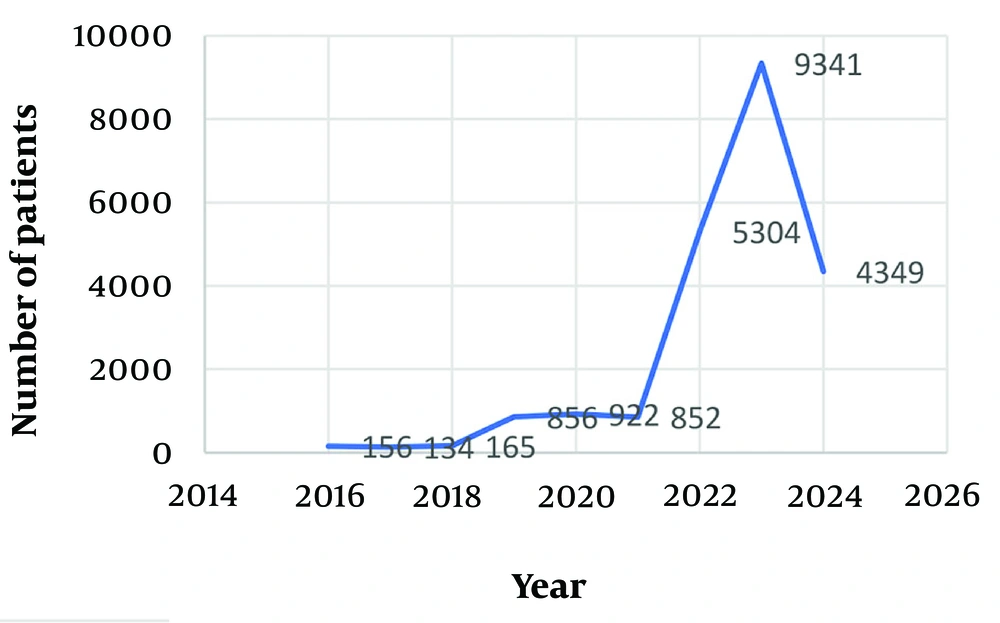
The current study offers a comprehensive overview of the malaria situation during a specific period, encompassing epidemiological data and factors predicting the incidence of this disease, utilizing a large sample size in Iran's Sistan-Baluchistan province. The findings of this study hold significant potential for health decision-makers, aiding in operational planning to control and prepare health facilities for malaria elimination efforts. During the studied period, there has been a general upward trend in the occurrence of malaria in Sistan-Baluchistan province. In 2016, a total of 156 cases were reported, which decreased slightly to 134 cases in 2017.
The implementation of the malaria elimination program in Iran, supported by the WHO since 2009, has played a role in restricting malaria transmission in the southern and southeastern regions of the country (
12). This information is supported by previous research, which indicated a decline in malaria incidence in Iran from 0.24 cases per 1000 people in 2002 to 0.01 cases per 1000 people in 2017 (
23). Our findings showed a notable rise in the incidence rate of malaria, with the number of infected individuals increasing from 165 cases in 2018 to 852 cases in 2021. Surprisingly, in 2022, there was a sudden and unexpected surge in the disease, resembling an epidemic, resulting in a significant increase to 5034 reported cases, and in 2023, the number of infected people reached 9341.
A study conducted in Iran in 2023 revealed that the number of individuals testing positive for malaria in Sistan-Baluchistan province was about ten times higher in 2022 compared to the previous year, 2021 (
2). The rise in malaria cases can be attributed to several factors, including an increase in malaria cases in neighboring countries such as Pakistan, as well as a rise in the number of migrant workers from these countries entering Iran. Additionally, the increase in temperature and heavy monsoon rains may have contributed to the spread of the disease. Improved diagnostic methods in recent years have also led to the identification of new cases (
2,
13). Furthermore, the coexistence of COVID-19 and malaria is believed to have played a role in the outbreak of malaria during this period (
24). It is crucial for the country's healthcare system to pay closer attention to the effective control of endemic diseases, particularly during the summer season.
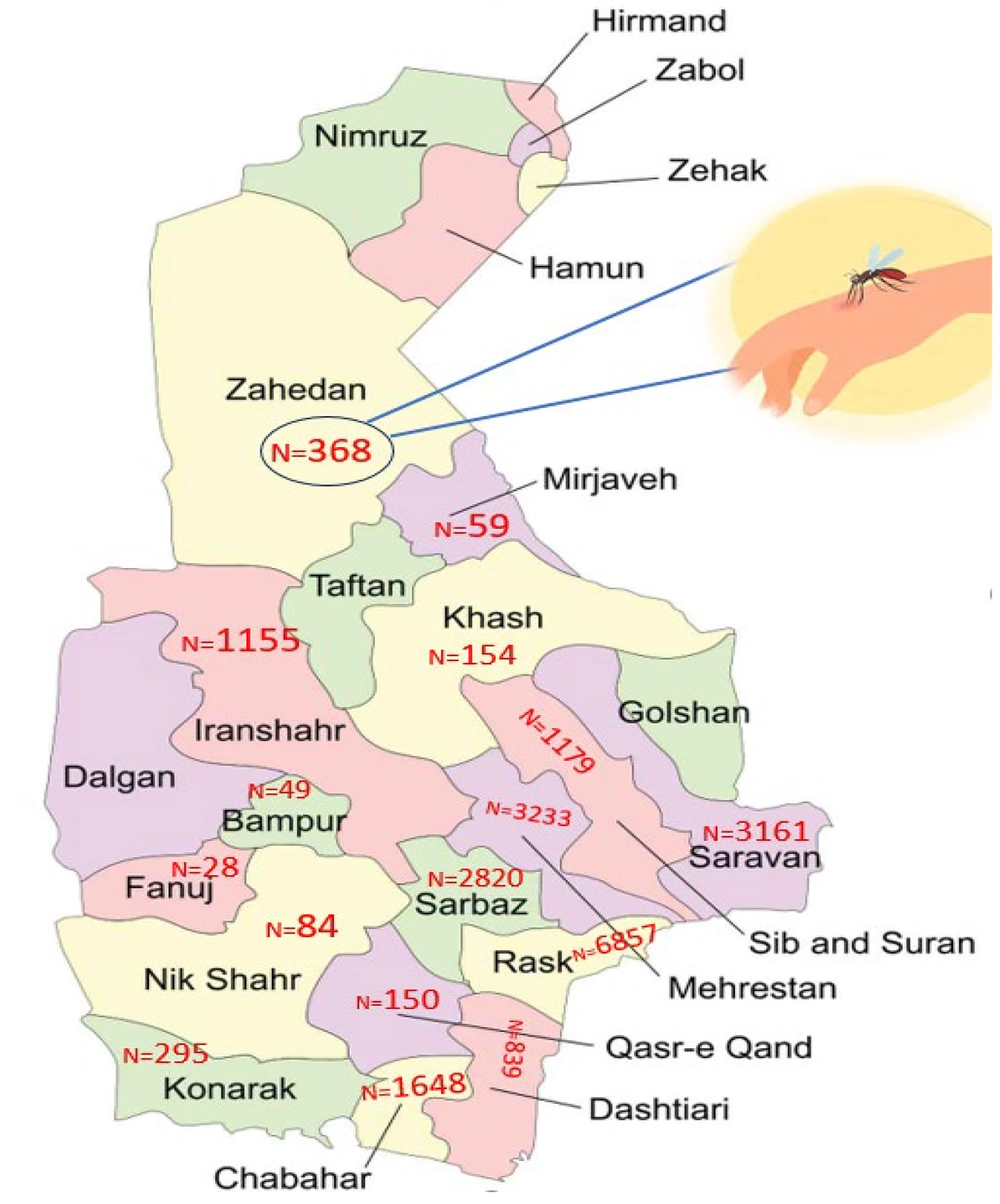
The present findings demonstrated that the cities of Rask, Mehrestan, Saravan, and Sarbaz, located near the Pakistan border, have the highest malaria incidence. It was also observed that approximately 65% of the infected individuals traveled to Pakistan during the year of infection. The migration of infected refugees from one malaria-endemic country to another can have various impacts on the spread of the infection. These refugees can transfer parasites to the host country and lead to the spread of infection (
14). Therefore, the health issues of immigrants should be considered a priority.
According to the results, the majority of malaria cases during the study period were observed in young and middle-aged individuals. This is consistent with the previous study in the southeast of Iran, which also reported a higher prevalence of the disease in people aged 12 and above (
25). This high ratio is attributed to occupational and behavioral factors that lead to greater contact with infectious carriers compared to women (
23). In this study, approximately 44.9% of infected individuals were drivers to the border areas of Pakistan.
Studies have shown that climate change has a significant impact on malaria and its vectors. Factors such as temperature, rainfall, relative humidity, intensity, and wind direction play crucial roles in the growth, reproduction, and spread of
Anopheles mosquitoes,
P. parasites, and malaria transmission (
26,
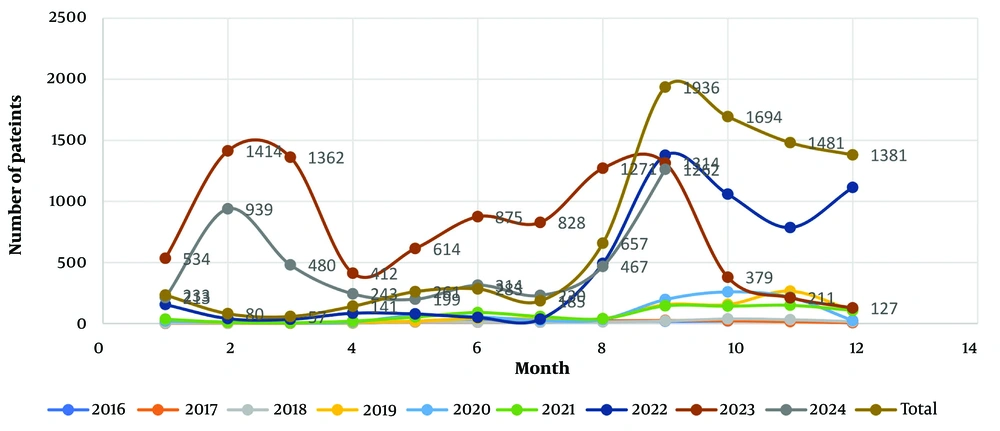
27). In the present study, the highest incidence of the disease was observed in September. Another study conducted in Iran indicated that the average monthly temperature below 30°C in September (specifically 29.2°C) was more favorable for the survival and abundance of adult mosquitoes, thereby facilitating their search for hosts (
28). Therefore, it is essential to consider climate change when planning malaria control strategies.
This study supports previous research, with Nili et al. warning that without proper interventions, malaria will continue to pose a health concern in southern Iran (
29). Furthermore, a critical factor influencing the transmission dynamics of malaria is the behavioral traits exhibited by
Anopheles mosquitoes, particularly their endophilic (indoor resting) and exophagic (outdoor feeding) preferences. Endophilic species generally rest inside human habitation, making them more vulnerable to control measures such as indoor residual spraying (IRS) and the deployment of insecticide-treated nets (ITNs).
Conversely, exophagic mosquitoes primarily obtain nourishment in outdoor settings, thereby constraining the effectiveness of control strategies that are predominantly indoor-focused. These behavioral tendencies highlight the imperative for comprehensive vector control approaches that are customized to the local mosquito ecology, which encompasses specific outdoor interventions, including larval source management and the application of spatial repellents (
30).
Our findings showed that
P. vivax was identified as the primary and most prevalent cause of malaria among all infected patients. This observation aligns with previous studies conducted in Iran, where this species of parasite was consistently found to be the predominant one. For instance, in studies conducted in Kermanshah and Mazandaran,
P. vivax accounted for 98% of all cases (
25,
31). Similarly, in the Konarak study, it constituted 91.5% of the cases, while in the Razavi Khorasan study, it comprised 96.4% of the cases (
32). Moreover, Rezaei Kahkha-Zhaleh et al., in their study in 2024, found that most malaria cases in Rask County in southeastern Iran were caused by
P. vivax, although the prevalence of
P. falciparum has been increasing in this area since 2022 (
25).
According to the World Health Organization report in 2024, 58 percent of malaria cases in the Eastern Mediterranean region are caused by vivax. Also, according to this report in Iran, although falciparum cases are increasing, most malaria cases in Iran are still related to vivax (
3). The results of the present study indicated that nearly 80% of patients received treatment within the first three days of diagnosis. This highlights the importance of conducting epidemiological investigations and maintaining a robust malaria surveillance system capable of effectively detecting active cases, especially asymptomatic cases (
33). Additionally, it is crucial to raise awareness among migrant families about the availability of proper malaria prevention services in primary healthcare centers.
Overall, in the malaria elimination program, it is imperative to ensure equitable access to malaria preventive measures for all individuals (
34). The result of this study showed that more men with malaria are diagnosed by the passive care system compared to women. Men may be less likely to seek medical care due to various reasons, such as reluctance to express emotions or concerns about their health, feelings of embarrassment, anxiety, fear, and poor communication with healthcare professionals (
35), which could contribute to the observed difference in diagnoses between men and women in the passive care system.
5.1. Limitations
Our study had limitations that should be considered. It was based on data sourced from the malaria surveillance system. Therefore, patients for whom the malaria diagnosis checklist was reported were included in the analysis, while patients whose information was not recorded due to lack of access were excluded. Additionally, the present study's findings are specific to only one province with unique conditions, and their generalization to other provinces should be approached with caution. Furthermore, socio-economic, environmental, and cultural factors affecting malaria transmission were not investigated in this study, limiting the depth of understanding of disease dynamics.
5.2. Conclusions
To effectively manage malaria in malaria-prone areas like Sistan-Baluchistan province, health decision-makers are advised to consider the following measures: Promptly treating individuals diagnosed with malaria and implementing vector control strategies, including IRS, long-lasting insecticidal nets, and environmental control measures in the southern areas. It is also important to increase awareness and vigilance regarding the symptoms of malaria, particularly among men, especially those working at the borders and drivers who transport goods across them. The country's healthcare system must pay closer attention to the effective control of endemic diseases, particularly during the summer season. Additionally, the health issues of immigrants should be considered a priority, and it is crucial to raise awareness among migrant families about the availability of proper malaria prevention services in primary healthcare centers. These measures will contribute to the proper management of the disease in these high-risk areas.