Malignant biliary obstruction is an ominous disorder of biliary obstruction and cholestasis caused by the invasion of malignant tumors (
14). Malignant biliary obstruction is accompanied by high mortality mainly due to tumor progression, liver failure, and sepsis (
15). Percutaneous transhepatic biliary stenting, characterized by minimal invasion and high efficiency, is a common therapeutic strategy for MBO. The development of
125I particle stents brings great advantages in prolonging biliary patency and survival time (
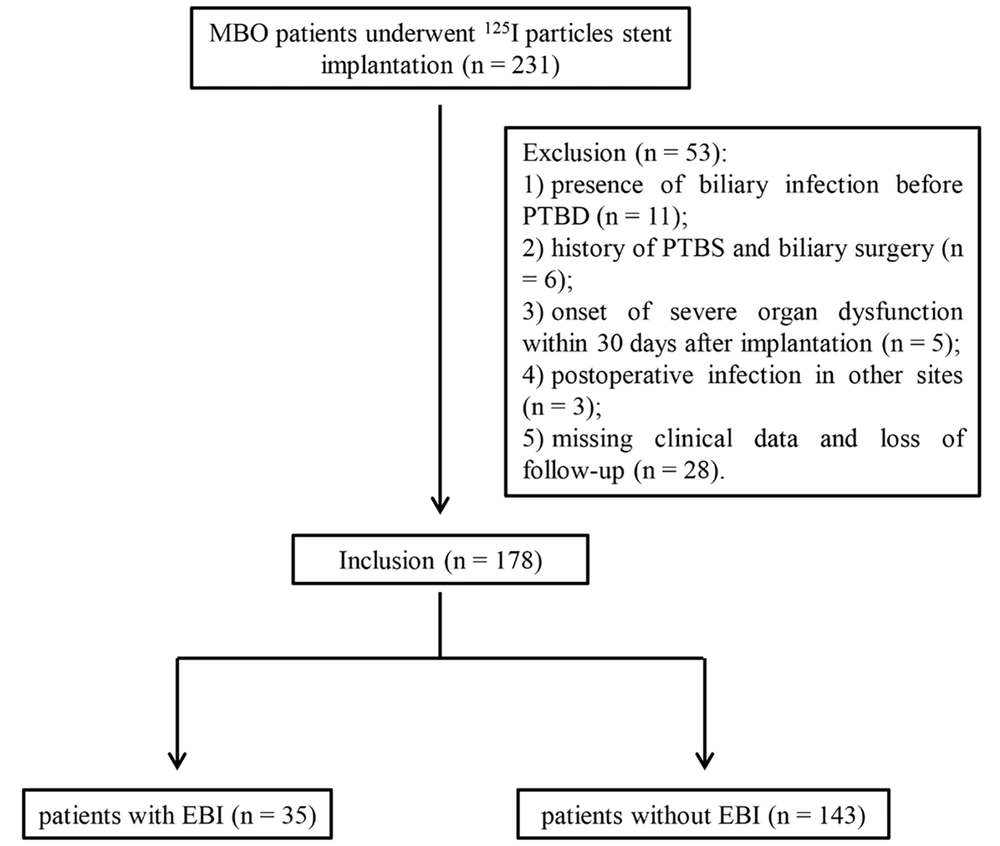
13). However, the onset of complications, including EBI, seriously affects the quality of life. In this study, EBI was observed in 35 patients (19.7%) after
125I stent implantation. Bile culture determined that the pathogens of EBI were mainly gut-derived bacteria, such as
E.coli,
K.pneumoniae, and
E.faecalis. Additionally, several risk factors for EBI were identified, including diabetes, gallstones in the gallbladder or bile ducts, high-level obstruction, short time from PTBD to
125I stent implantation, intraoperative biliary bleeding, and postoperative intrahepatic pneumobilia.
Diabetes is a common metabolic disease characterized by hyperglycemia (
16). Many previous studies have identified diabetes as a risk factor for EBI after PTBS (
11,
13). In this study, diabetes was more frequent in the EBI group than in the non-EBI group and was subsequently determined to be a risk factor for EBI after
125I particle stent implantation. Our findings are consistent with previous studies, illustrating that diabetes is a risk for the onset of EBI following
125I particle stent implantation. The possible mechanisms include: (1) the reduction of insulin with anti-inflammatory effects (
17); (2) weakened immune defense, leading to microbial invasion and infection (
18); (3) diabetes-associated vascular disorders affecting blood flow around the bile duct, benefiting the growth of anaerobic bacteria under a hypoxic environment (
19); and (4) hyperglycemia benefiting the growth of many bacteria in the bile duct (
20). Therefore, preoperative control of blood glucose is urgently needed for patients requiring
125I particle stent implantation.
Gallstones grow inside the gallbladder or biliary tract, causing intermittent obstruction of the cystic duct (
21). Gallstones can lead to a series of disorders, such as pain, jaundice, infection, and acute pancreatitis (
22). A previous study reported that gallstones are a risk factor for cholecystitis within 30 days after PTBS (
23). In this study, gallstones in the gallbladder or bile ducts were determined to be a risk factor for EBI after
125I particle stent implantation. This result demonstrates the adverse role of gallstones in the outcomes of
125I stent implantation. The underlying mechanisms may be that gallstones can block the stent with the contraction of the gallbladder and the flow of bile, and the obstruction-induced cholestasis benefits bacterial growth, contributing to EBI. To avoid the adverse effects of gallstones, premature removal of PTBD drainage tubes is not recommended after stent implantation. When gallstones block the stent, they can be removed through the drainage tubes.
The location of obstruction is closely associated with the risk of biliary infection after drainage. Zhou et al. reported that the location of obstruction is a risk factor for EBI following PTBS (
24). Consistent with previous studies, this study also revealed that high-level obstruction is a risk factor for EBI after
125I particle stent implantation. High-level biliary obstruction is characterized by an insidious onset and special anatomical location, which may lead to an increased risk of stent implantation and predispose to a variety of complications, such as EBI (
25). For patients with high-level obstruction, accurate location of the obstruction based on preoperative cholangiography is necessary, and an appropriate stent should be customized to achieve sufficient drainage and reduce the risk of EBI.
Intraoperative biliary bleeding may occur due to mechanical damage caused by punctures, wire guides, and stents (
26). Biliary bleeding can increase the risk of biliary infection by bringing contaminated bile into the bloodstream. Liu et al. reported that intraoperative biliary bleeding is an independent risk factor for EBI after PTBS (
13). Consistently, this study also revealed that intraoperative biliary bleeding is a risk factor for EBI after
125I particle stent implantation. Therefore, avoiding vascular damage during interventional therapy is particularly important for reducing the risk of EBI.
Under normal circumstances, no gas is present in the bile duct. In this study, postoperative intrahepatic pneumobilia was observed in 75 cases after 125I particle stent implantation, which was more frequent in the EBI group than in the non-EBI group. The subsequent analysis determined a positive correlation between postoperative intrahepatic pneumobilia and EBI. The respiration of some bacteria contributing to EBI may lead to the onset of intrahepatic pneumobilia. After identifying bacterial gas in patients with postoperative intrahepatic pneumobilia, the drainage tube should be temporarily retained for flushing bile ducts.
The time from PTBD to
125I implantation was further determined to be a protective factor for EBI. Patients with MBO usually have impaired immune function (
27). Hyperbilirubinemia can further weaken cellular defense responses by stimulating cytotoxic reactions (
28). Given that the normal protective barrier of the bile duct is easily damaged, interventional therapies, including PTBD, have a high risk of inducing biliary infection. Therefore, it is better to wait for the improvement of bilirubin, liver and coagulation function, and remission of edema in the bile duct wall before
125I particle stent implantation. Our findings indicate that an appropriate extension of the time from PTBD to
125I stent implantation is beneficial to reducing the risk of EBI.
In conclusion, patients with MBO have a relatively high incidence of EBI (19.7%) after 125I particle stent implantation. Diabetes, gallstones in the gallbladder or bile ducts, high-level obstruction, intraoperative biliary bleeding, and postoperative intrahepatic pneumobilia are risk factors for EBI. The time from PTBD to 125I stent implantation is a protective factor for EBI. However, this study is based on data from a single center with a limited sample size, potentially leading to biased results. The risk factors of EBI are not only limited to those elucidated in this study. Further research with a larger sample size and consideration of additional factors, such as the time of onset of malignancy, patient weight loss and malnutrition, and immunosuppression, is warranted.