


1. Background
In recent decades, inspired by Aristotle's virtue ethics, various models have been proposed to elucidate the concept of well-being. Educational and developmental psychologists, drawing upon Aristotelian principles and within the framework of positive psychology, have sought to create models of well-being tailored to the educational and school context. Their rationale is that since schools play a central role in students' lives, their well-being should be defined in relation to the school environment and educational conditions. This led to the emergence of the concept of academic well-being (1, 2). Academic well-being was developed to link emotional and academic functioning and enhance the relationship between the learner and the school (3).
Prior research has utilized various theoretical frameworks to assess well-being promotion in educational settings, resulting in several models (4). Among the most prominent is Ryff's (5) model of psychological well-being, which serves as a foundation for understanding academic well-being. Ryff explored psychological well-being within the context of human development, defining it as the pursuit of excellence that facilitates the realization of one's full potential. Building on this model, adolescents who perceive a sense of independence and autonomy, and who base life decisions on their beliefs, are likely to experience a higher level of psychological well-being in their academic pursuits (5).
Academic well-being, distinct from psychological well-being, refers specifically to students' positive experiences and feelings related to their academic endeavors. It encompasses factors such as academic motivation, engagement, and self-efficacy (6). Given the importance of academic well-being for student success, the present study aims to investigate the factors that influence it.
A growing body of research has demonstrated a positive association between parental academic support and students' academic well-being (7). According to Hamedi et al. (8), academic support encompasses any resource that directly or indirectly fosters students' motivation, engagement, and academic performance. Emotional support (providing encouragement), instrumental support (assisting with homework), and cognitive support (emphasizing the importance of academic success) stand out as primary dimensions of this support. Teachers, peers, and parents can help students connect their learning activities to personal goals and interests, leading to enhanced academic well-being (9, 10). Supporting this notion, studies by Mahmoodimehr et al. (11) and Chaudhry et al. (12) have established a direct relationship between academic support and academic well-being among students.
Research has demonstrated a positive association between academic resilience and students' academic well-being (13). Academic resilience, a crucial factor in students' academic success, refers to the ability to overcome challenges and setbacks in the educational environment (14). It can be cultivated by teachers and educators, making it a valuable focus for intervention (15). The dimensions of academic resilience include cognitive adaptation, behavioral adaptation, cognitive maladaptation, and behavioral maladaptation (16). Academic resilience aligns with the principles of positive psychology, emphasizing intrinsic motivation and the energizing effects of self-directed engagement. For students with high academic resilience, academic pursuits become a source of personal growth and satisfaction rather than a drain on their energy (17). These students remain strongly motivated to achieve, even when faced with challenges and setbacks that might discourage others. Empirical evidence supports the link between academic resilience and academic well-being (18). Yang and Wang (19) found a significant positive relationship between the two constructs, indicating that students with high academic resilience tend to experience more positive emotions, engagement, and satisfaction in their academic efforts.
Student academic well-being is critical for their academic progress. It fosters a positive and productive learning environment where students can actively participate and thrive. Research suggests that academic well-being is a key outcome variable in education, often studied as a component of educational quality (20). The increasing focus on student well-being reflects educators' interest in creating successful learning environments. While the importance of student well-being is widely recognized, the factors influencing it are still being explored.
2. Objectives
This study aims to address this gap by investigating the relationship between parental academic support and student academic well-being in secondary schools. Specifically, we aim to understand how academic resilience mediates this relationship. In other words, we will explore how parental academic support influences student well-being through the development of academic resilience.
3. Methods
This study employed a descriptive-correlational design to explore the relationships between the variables under investigation using structural equation modeling (SEM). The target population consisted of all high school students in Ahvaz, Iran, during the academic year 2022 - 2023. A multistage cluster sampling method was used. First, District 3 of the Ahvaz Department of Education was randomly selected from the city's four districts. Then, six all-girls high schools (three junior high and three senior high schools) were randomly chosen from this district. Within each selected school, two classes were also randomly chosen. After obtaining informed consent from principals and teachers, research questionnaires were distributed to the students in the selected classes. After excluding incomplete or distorted questionnaires, the final sample size was 384 students.
A power analysis was conducted to determine the appropriate sample size based on the number of research variables included in the study, indicating that 384 participants would provide sufficient statistical power. Inclusion criteria required informed consent from both students and parents, the absence of learning disorders or psychological issues, and confirmation that the students were within the targeted age range (13 - 18 years). The only exclusion criterion was failure to complete all items on the questionnaire.
3.1. Instruments
3.1.1. School-Related Well-Being Scale
The School-Related Well-Being Scale (SWBS), developed by Pietarinen et al. (21), is a well-being measure designed for students in school settings. This 11-item instrument uses a 5-point Likert Sscale (ranging from 1 to 5) for scoring. Pietarinen et al. (21) established the SWBS as having acceptable validity and reliability, with a Cronbach's alpha of 0.75. The possible scores on the SWBS range from 11 to 55, with higher scores indicating greater well-being among students. Mohammadi et al. (22) found that the Persian translation of the questionnaire achieved a Cronbach's alpha of 0.78, demonstrating good internal consistency.
3.1.2. Academic Support Scale
To assess perceived academic support from parents, a modified version of the Academic Support Questionnaire (23) was used. The original instrument consisted of 24 items rated on a 4-point Likert Scale (1 = "strongly disagree" to 4 = "strongly agree"). It measured academic support from peers, teachers, fathers, and mothers, with six items per subscale (23). For this study, which focused specifically on parental support, only the "Academic Support from the Father" and "Academic Support from the Mother" subscales were used, resulting in a 12-item measure. Samani and Jafari (24) reported a Cronbach's alpha of 0.85 for the scale, indicating good internal consistency.
3.1.3. Academic Resilience Scale
The Academic Resilience Scale was assessed using a 6-item measure developed by Martin and Marsh (25). This instrument utilizes a 5-point Likert Scale (1 = "strongly disagree" to 5 = "strongly agree") with response options capturing varying degrees of agreement ("somewhat agree," "no comment," and "somewhat disagree"). Total scores range from 6 to 30, with higher scores indicating greater academic buoyancy, or students' capacity to navigate academic challenges. The Persian version of the scale demonstrated good internal consistency, with a Cronbach's alpha coefficient of 0.87 reported by Darabi et al. (26).
3.2. Data Analysis
The data analysis procedures focused on assessing normality, examining relationships between variables, and evaluating the model. Skewness and kurtosis statistics were used to assess the normality of the data. Pearson's correlation coefficient was employed to explore the bivariate relationships among the study variables. Structural equation modeling was conducted using SPSS 25 and AMOS 25 to evaluate the hypothesized relationships within the model. Additionally, bootstrapping procedures were applied to determine the significance of indirect effects.
4. Results
Participant demographics indicated an average age of 16.19 years (SD = 2.66). Nearly half of the participants (48.70%, n = 187) were junior high school students, while the remaining (51.30%, n = 197) were in senior high school. Descriptive statistics for the study variables, including means, standard deviations, and correlation coefficients, are provided in Table 1.
Table 1.Descriptive Findings and Pearson Correlation Coefficients of the Research Variables
a P < 0.05.
b P < 0.01.
As shown in Table 1, Pearson's correlation coefficients revealed significant relationships (P < 0.05) among all the study variables. An initial model illustrating the relationship between parental academic support and academic well-being, mediated by academic resilience, is depicted in Figure 1.
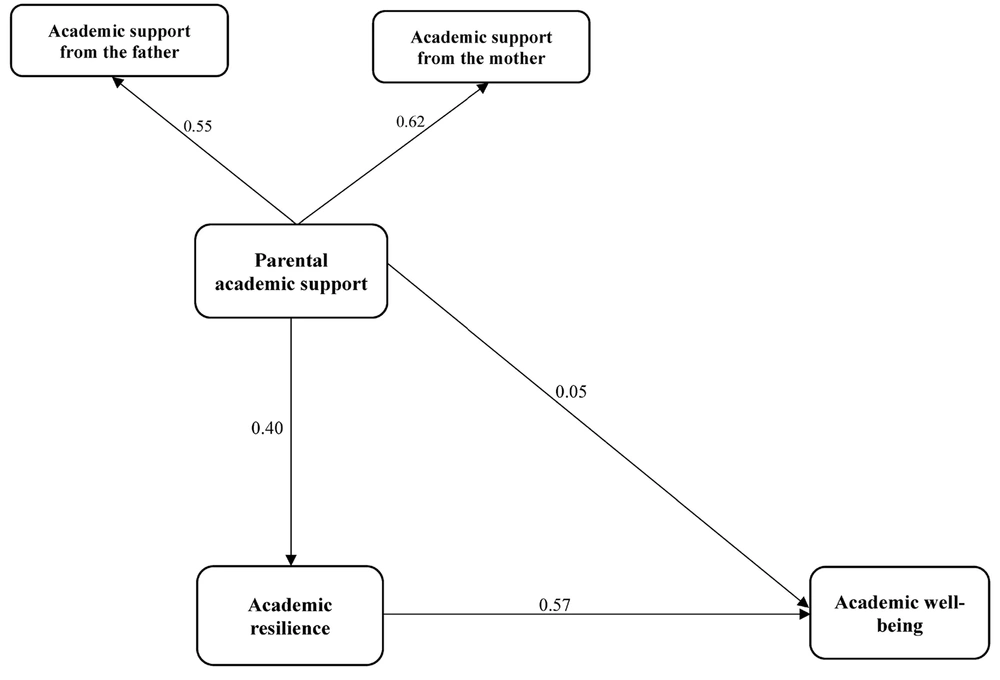
Figure 1.
The initial model
Based on the data in Table 2, the Root Mean Square Error of Approximation (RMSEA) Index (RMSEA = 0.324) suggested that the initial model required modification. As a result, the path from parental academic support to academic well-being was removed. The modified model is shown in Figure 2. In the final model, the RMSEA index improved to 0.001, indicating a good fit for the model.
Table 2.Fit Indicators of the Initial and Final Models
| Fit Indicators | χ2 | df | (χ2/df) | TLI | CFI | RFI | NFI | RMSEA |
|---|---|---|---|---|---|---|---|---|
| Initial model | 0.12 | 1 | 0.12 | 0.99 | 0.99 | 0.99 | 0.99 | 0.324 |
| Modified model | 0.68 | 2 | 0.34 | 0.99 | 0.99 | 0.99 | 0.99 | 0.001 |
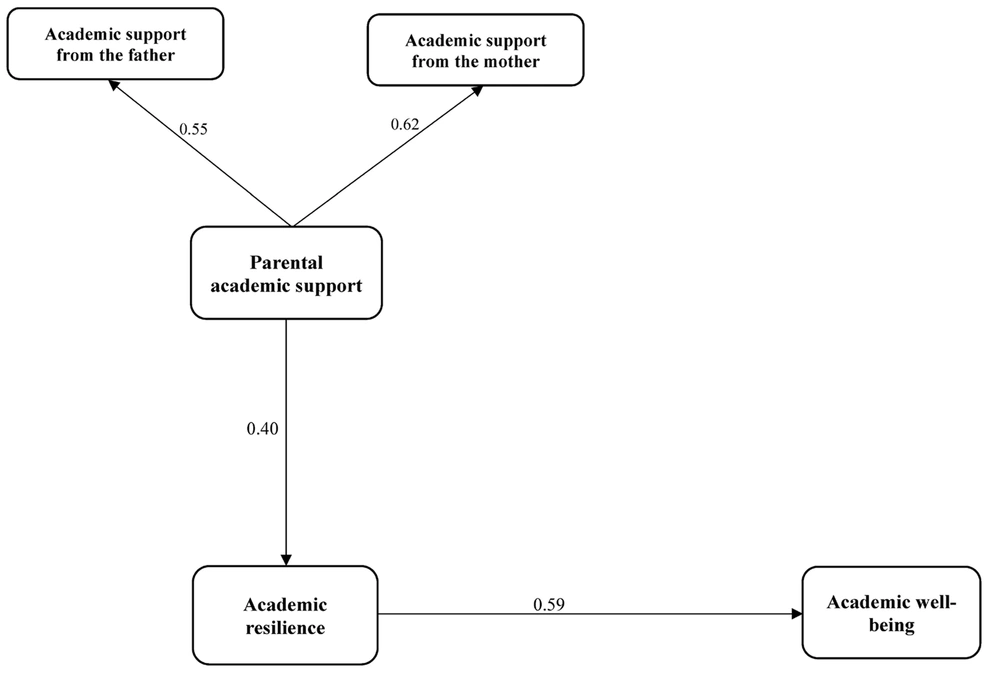
Figure 2.
The modified model
Table 3 presents the estimated path coefficients for the hypothesized direct and indirect relationships in the model. Parental academic support showed a significant positive association with students' academic resilience (P < 0.001). Likewise, academic resilience demonstrated a significant positive relationship with academic well-being (P < 0.001). Notably, the results did not reveal a direct association between parental academic support and academic well-being. However, an indirect effect of parental academic support on academic well-being was identified through the mediating role of academic resilience (P = 0.006). These findings suggest that parental academic support indirectly influences students' academic well-being by enhancing their academic resilience.
Table 3.Direct and Indirect Paths Coefficients in the Modified Model
| Paths | Modified Model | |
|---|---|---|
| β | P | |
| Parental academic support → academic well-being | 0.05 | 0.231 |
| Parental academic support → academic resilience | 0.40 | 0.001 |
| Academic resilience → academic well-being | 0.59 | 0.001 |
| Parental academic support → academic well-being through academic resilience | 0.20 | 0.006 |
5. Discussion
This study aimed to examine the relationship between parental academic support and academic well-being, with academic resilience serving as a mediator. The first key finding indicated that parental academic support was not directly associated with academic well-being. This result contrasts with previous studies by Jang and Suh (7) and Mahmoodimehr et al. (11), which found a significant positive association using correlation and regression analyses. Unlike these studies, the present research utilized SEM to test the hypotheses. Initially, the Pearson correlation test revealed a significant relationship between parental support and academic well-being. However, in the SEM, academic resilience fully mediated the effect of parental support on academic well-being, suggesting an indirect relationship. In other words, while parental support influences academic well-being, it does so through the enhancement of academic resilience.
This finding suggests that social support from family, teachers, and friends can shield students from the negative effects of stress and help foster self-esteem and a sense of self-worth. Emotional, instrumental, and cognitive support are the primary dimensions of academic support (27). The key sources of academic support—parents, peers, and teachers—each play unique roles in students' academic success (28). According to these authors, these sources transmit values and expectations, provide guidance and feedback, maintain a safe learning environment, and offer emotional support to students. Academic support is multifaceted, with teacher-student, teacher-parent, and parent-teacher interactions collectively playing a significant role in enhancing students' academic well-being (29).
The study also found a significant positive relationship between academic resilience and academic well-being, consistent with the findings of Sun and Liu (6) and Siebecke (13). This can be explained by the theoretical frameworks of resilience, which suggest that resilience results from a combination of protective factors within and outside the individual, as well as risk factors in their social and academic environment. Resilient individuals possess intrapersonal and interpersonal protective factors that outweigh the risks they face. Resilient students develop competencies such as collaboration, communication, problem-solving, goal-setting, academic skills, self-efficacy, and self-determination, which allow them to better cope with academic challenges and maintain their well-being (30).
Resilience not only helps students face academic challenges effectively but also fosters greater engagement with their studies, leading to enjoyment, dedication, and immersion in academic tasks. Utilizing strategies associated with resilience—such as persistence, reflection, adaptive help-seeking, and managing negative emotions—enables students to handle the stresses of academic demands and expectations while enhancing their sense of academic competence and engagement (31).
Additionally, the findings revealed a significant mediating effect of academic resilience on the relationship between parental academic support and academic well-being. While the initial hypothesis anticipated a direct link between parental academic support and academic well-being, the results did not provide statistically significant evidence for this direct association. However, the indirect hypothesis was supported, indicating that parental academic support influences academic well-being only when it first enhances students' academic resilience.
This highlights the importance of educating parents on how their involvement can positively impact their children's academic success, motivating them to take a more active role in their education. Often, parents adopt a passive approach due to a lack of understanding regarding how to support their children. However, parents are valuable allies for teachers and counselors in helping students achieve their educational and developmental goals. Therefore, strategies to increase parents' awareness of their potential role are essential. A review of existing research in education, including studies related to this topic, underscores the critical influence of family on children's academic achievement (7, 9). A majority of research consistently recognizes family involvement as a crucial factor in academic performance.
Given the role of parental support in alleviating students' stress and helping them navigate minor challenges, it is important to organize parent-teacher meetings and establish parent-teacher associations. This would help inform parents of their pivotal role in addressing students' difficulties and aligning with educational goals (10). Such initiatives could reduce the burden on the educational system by minimizing student misalignments and enhancing overall outcomes. The educational community can further encourage growth by providing strategies in schools and developing textbooks that promote societal advancement. Success in these efforts requires alignment with parental perspectives, as parents are key contributors to improving educational results. Based on the findings of this study, educating parents on how their support positively affects students' personality development, perseverance, and chances of future success would be a constructive step toward nurturing competent and effective individuals in society.
Thus, it can be concluded that academic resilience effectively mediates the relationship between parental academic support and academic well-being.
This study, however, focused on female high school students in Ahvaz City, limiting the generalizability of the findings to other populations. Caution is needed when applying these results to different genders, age groups, or geographic locations. Additionally, incomplete data due to missing responses in some questionnaires led to the exclusion of certain participants, potentially introducing sampling bias that could affect the representativeness of the final sample.
5.1. Conclusions
This study identified a positive and statistically significant association between parental academic support and academic resilience. Students who receive greater parental support tend to develop stronger academic resilience. Moreover, the study found a significant positive relationship between academic resilience and academic well-being, suggesting that students with higher resilience experience greater satisfaction and positive emotions in the academic context. Notably, there was no direct link between parental academic support and academic well-being, but an indirect effect was observed, showing that parental support fosters academic resilience, which in turn enhances academic well-being.
These findings contribute to our understanding of the complex interplay between parental involvement, academic resilience, and student well-being, emphasizing the importance of parental support in developing resilience that ultimately benefits students' academic experiences. Future research could investigate the specific mechanisms through which parental support fosters academic resilience and explore additional factors that may contribute to student well-being.
