


1. Background
The COVID-19 pandemic brought profound changes to nearly every facet of daily life (1). Widespread lockdowns and social distancing measures significantly increased public reliance on social networks and technology (2). As schools closed and in-person learning became impractical, educational systems worldwide underwent dramatic transformations, with many countries adopting e-learning, distance education, and digital platform-based teaching as alternatives (3). In the post-pandemic era, technological tools such as smartphones, tablets, laptops, and the internet have become indispensable to both everyday life and education (4). This new learning environment has not only reshaped teaching and assessment methods but has also altered learning styles and behaviors for both educators (5) and students (6).
In Iran, the onset of the pandemic led to the development and implementation of the "Shad" student network. This platform became the primary medium for delivering non-in-person school classes, offering features such as messaging for audio, video, and text file sharing, live calls, and an archive of educational content created by top educators in the country (7, 8). Although the COVID-19 pandemic has subsided, the challenges of distance education remain relevant due to ongoing climate change and weather conditions in Iran. In 2023 and 2024, schools have frequently been closed due to air pollution and severe weather, prompting the continued use of distance learning. This stands in contrast to the pre-pandemic era when, except in some cases and special schools, education was mainly based on in-person learning.
Recognizing the significance of these changes, researchers have increasingly focused on the benefits and drawbacks of online and offline remote or distance learning across various disciplines, including medicine, nursing, health (5), English language (9), mathematics (10), and physical education (11). A key concern has been the challenge of effectively supporting courses like physical education, which differ fundamentally from knowledge-based courses (12). Physical education is inherently practical and movement-oriented (12), often requiring in-person instruction and practice (13). The unique physical and sensory-motor characteristics of motor skills learning—a primary focus of physical education—pose particular challenges in distance education settings. This issue is especially critical in Iran, where physical education is a core subject taught across all grades from elementary to high school. As such, PE classes demand specialized preparation, communication, and delivery methods to ensure that educational objectives are met effectively (14).
Physical education is highly valued in the macro educational policies of the country, and achieving the educational system's goals in the physical and psychological development of students is a critical issue that is receiving increasing attention. Ensuring the effective delivery of this course is becoming increasingly important. Given the potential challenges to in-person education—such as pandemics, pollution, and adverse weather—it is essential to develop alternative methods that can match or complement traditional instruction. Options like online web conferences, flipped classrooms (15), and blended learning are viable solutions (16). Traditional in-person learning, with its immediate feedback and close supervision (17), is well-suited for teaching motor skills (18). However, online education offers flexibility in timing and location, access to diverse resources, and opportunities for self-directed learning (19), making it a promising alternative. Despite these benefits, online and offline environments often lack immediate feedback and interaction, which can impact learning quality (17).
Although the Shad student network was designed to address various educational needs, challenges remain. During COVID-19, due to the absence of a well-rounded physical education program, Iranian PE teachers on the Shad platform mainly focused on delivering knowledge-based content, such as nutrition, fitness, and basic sports, rather than actively engaging students in physical activities. This is concerning since the main goal of physical education is to develop motor skills (20)—something that distance learning courses, particularly those relying on online and offline education, often fail to achieve effectively.
Much of the research on the effectiveness of distance learning (online or offline) versus traditional in-person education has emerged post-COVID-19 (21), with a primary focus on creating and developing suitable and effective distance learning models and examining the challenges of online education, particularly in theoretical courses for university students (11). However, studies on physical education and motor skills training for school-age children are limited, and the few available studies often overlook the primary objectives and nature of physical education classes (17, 18). Elementary school students, with their different approaches to using social media and technology, and their lower capacity for self-regulation in online learning (22, 23), may behave differently and have distinct needs compared to university students. To meet the goals of physical education, teachers often need to adapt PE classes and modify teaching methods based on current conditions. On the other hand, many of these studies have used descriptive study designs to make comparisons, often relying on preference surveys and existing reports to assess the effectiveness of online versus in-person learning (12).
Given this, the present study aims to determine whether distance online classes conducted on domestic platforms using common methods are as effective as in-person classes for teaching and learning motor and sports skills. Additionally, it seeks to explore whether online remote or distance learning classes can serve as a viable alternative during critical situations.
2. Objectives
The objective of this study is to compare the effectiveness of in-person and online distance education methods in the acquisition of motor skills in physical education classes.
3. Methods
The present research is a semi-experimental study with a pre-test and post-test design. The research was conducted with the informed consent of both parents and students.
3.1. Subjects
For this purpose, 40 girl students aged 9 to 11 voluntarily participated in the study and were randomly assigned to two groups: In-person education (average age 10.15 ± 0.67) and online education (average age 10.05 ± 0.60).
3.2. Apparatus and Tasks
3.2.1. Initial Data Collection
A personal information questionnaire was used to gather initial information regarding physical health and the absence of movement disorders or injuries.
3.2.2. Exercise Tools
A standard jump rope appropriate for each participant's height was used throughout the different stages of the exercise.
3.2.3. Smartphone
Participants in the online group used smartphones to receive videos and verbal instructions.
3.2.4. Performance Evaluation
A standardized 30-second test in various jump rope techniques was employed to evaluate participants' performance.
3.3. Procedure
After obtaining the necessary permits, making initial arrangements, and coordinating with an elementary school, interested students were invited to participate in the study. Following parental informed consent, students were randomly divided into two groups: In-person training and online training (each group consisting of 20 fourth-grade students). The participants had no prior experience with jump rope techniques; the only pattern they might have previously learned was the basic single jump technique (BSJT). All individuals, regardless of group, participated in three phases of testing: Pre-test, post-test, and retention test. During each test phase, the performance of each jump rope pattern was recorded for 30 seconds (according to the Ministry of Education’s jump rope competition standards). The pre-test and post-test included a 30-second record of the BSJT. It is noteworthy that the pre-test involved only the BSJT, as the criterion for entering the study was having no prior familiarity with various jump rope techniques. Only participants who were completely unfamiliar with jump rope techniques or had only learned the BSJT without formal training from a coach were included. The retention test measured the average score of 10 techniques, each lasting 30 seconds, conducted one week after the completion of the acquisition sessions. Each participant attended 8 acquisition sessions, each lasting 45 minutes, following the pre-test. Both the in-person and online training sessions were managed by a certified physical education teacher. Both training protocols were designed and conducted in accordance with the Ministry of Education’s guidelines and were conducted in groups.
The training sessions included:
- Session 1: Introduction to appropriate jump rope equipment (shoes and rope), safety tips, proper jump rope hand grip, measuring the rope according to height, and initial stance, including a specific warm-up for jump rope.
- Session 2: Single-hand rope rotation, rhythm coordination and jumping, two types of jumping rhythms (single and double bounce) for the BSJT, and a simple game for rhythm acquisition.
- Session 3: Side swing.
- Session 4: Lazy step and lazy side step.
- Session 5: Sprints.
- Session 6: Single toe-to-toe and single heel-to-toe.
- Session 7: Cross step, twisters, and scissor step.
- Session 8: Side to side, front to back, side straddle (jump rope jack).
Each session included: Warming up (10 minutes), reviewing the previous session, receiving the performance report, technical correction (5 minutes), presenting the main content of the session and practice (25 minutes), cooling down (5 minutes), and assigning homework and tasks for the next session.
The feedback method in both groups was self-regulated and provided only upon the students' request. Starting from the second session, students who correctly completed the assigned exercises and tasks or provided reports on their performance (regardless of the successful execution of the skill and technique) were publicly acknowledged for their participation and persistence. In the online group, there was an option for text or voice questions and answers during the class through the platform. If a student posed a question publicly in the class group, the answer was given to the entire class. If a student requested technique correction, they could privately send their video to the teacher within 15 minutes after the 45-minute class period to receive feedback appropriate to their performance. The educational content for the online group was based on the official content produced by the Ministry of Education and delivered through the Shad student network. The necessary explanations, assigning homework, answering questions, and class management were handled by the same teacher who also managed the in-person class. In the in-person class, the teacher was entirely responsible for demonstration, verbal instructions, providing feedback, and assigning homework and tasks. It is noteworthy that in managing both classes, efforts were made to ensure all aspects of class management and content adhered to the Physical Education Teacher’s Handbook and the policies and frameworks set by the Ministry of Education. Immediately after the eighth training session, both groups conducted a post-test similar to the pre-test (30 seconds of BSJT). One week after the acquisition sessions, the average scores of individuals in 10 techniques (side swing, lazy side step, sprints, single heel-to-toe, cross step, twisters, scissor step, side to side, front to back, and side straddle) were recorded for between-group comparison in the retention test. The test evaluation at all stages was conducted by researchers.
3.4. Data Analysis
In this study, means and standard deviations were used to describe the research variables. Additionally, given the verification of parametric assumptions (multivariate normality assessed with the Shapiro-Wilk test and homogeneity of variances between groups confirmed by the Levene test), a 2 × 3 mixed ANOVA was used for between-group (online and in-person) and within-group (pre-test, post-test, and retention) comparisons. The Bonferroni post-hoc test was also used for pairwise comparisons. The results were analyzed using SPSS version 26, with a significance level set at P ≤ 0.05.
4. Results
Given the adherence to the assumptions of parametric statistics (normality of data distribution based on the Shapiro-Wilk test and homogeneity of variances between groups based on the Levene test), a 2 (online vs. in-person education) × 3 (pre-test, post-test, and retention) mixed ANOVA was used. According to the results, the main effects of the test and the group were statistically significant (Table 1).
Table 1.The Results of Mixed ANOVA
| Source of Variance | Sum of Squares | df | MS | F | P-Value | Partial eta Squared |
|---|---|---|---|---|---|---|
| Test | 4686.8 | 1.81 | 2343.44 | 56.23 | 0.0001 | 0.59 |
| Group | 1882.84 | 1 | 1882.84 | 8.48 | 0.006 | 0.18 |
| Group × test | 214.89 | 1.81 | 107.44 | 2.57 | 0.08 | 0.06 |
| Within group error | 3166.91 | 68.92 | 45.93 | |||
| Between group error | 8433.79 | 38 | 221.94 |
The results of the Bonferroni test for pairwise comparisons of the main effect of the test indicated a significant difference between the pre-test and both the post-test and retention (P ≤ 0.001). Participants' records in the BSJT showed significant improvement from the pre-test (17 ± 1.86) to the post-test (26.35 ± 1.91). Additionally, there was a significant difference between the post-test and retention (11.17 ± 0.69) (P ≤ 0.001), reflecting overall learning from all the taught models.
Pairwise comparisons between the two groups revealed a notable advantage for the in-person group (22.13 ± 1.92) compared to the online group (14.21 ± 1.92) (P = 0.006). The Bonferroni post-hoc test results for the interaction effect showed significant differences between some levels of the factors. Specifically, although no significant differences were observed between the online and in-person groups in the pre-test (P = 0.18) and post-test (P = 0.06), a significant difference was found in the retention (P ≤ 0.001). The in-person education group (16.91 ± 0.92) had a significantly higher score than the online training group (5.44 ± 0.98), indicating a clear benefit for in-person training (Figure 1).
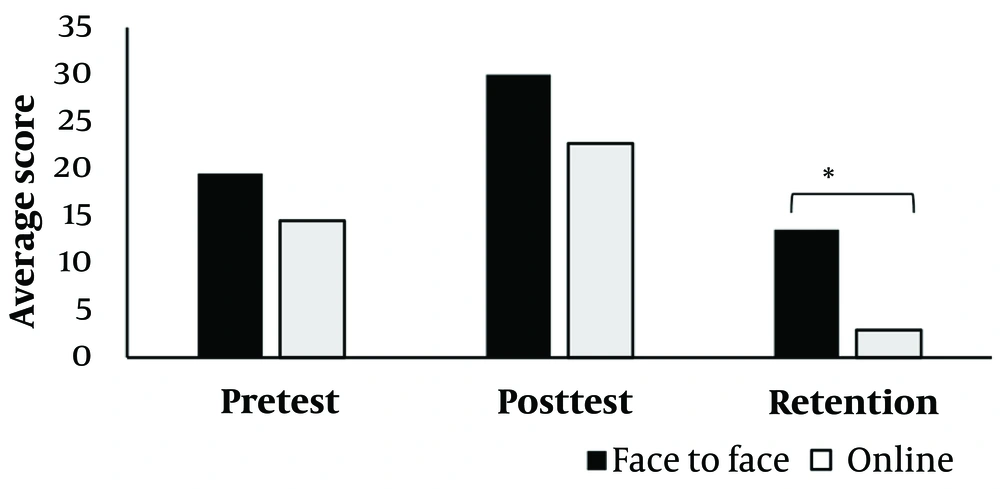
Figure 1.
The average scores of the research groups in the pre-test, post-test and retention. *: P ≤ 0.05.
5. Discussion
The aim of this study was to compare the effectiveness of two educational methods—in-person and online—in learning motor skills, specifically jump rope skills. The first finding indicated a significant main effect of the test, showing that both training methods positively impacted participants' jump rope skills from pre-test to post-test. This result aligns with previous research, which suggests that continuous practice and training, particularly in motor skills, can lead to performance improvement (24). These findings are consistent with earlier studies on the effectiveness of online education and in-person training, indicating that both methods can significantly enhance the acquisition of motor skills (25).
Both online and in-person training groups improved their jump rope skills significantly, but in-person training had a much greater impact, consistent with most research (12). In-person training allowed participants to interact directly with the instructor and receive immediate feedback (26), reducing delays in correcting mistakes and mastering techniques. This is particularly crucial for learning motor skills, which require precision and continuous refinement (27). The physical presence of the instructor and peers also fostered an encouraging and supportive environment, enhancing motivation and commitment to learning. While both training methods used modeling and verbal instructions, live modeling in-person offered closer observation and immediate explanations, whereas video modeling in online training allowed repeated viewing and self-paced learning (28). Additionally, in-person training enabled participants to observe both the expert model and peers, as well as the feedback given to others, providing more information for beginners. Thus, the differences between live and video modeling cannot be overlooked (28).
The study's latest findings reveal no significant difference between the online and in-person training groups in the pre-test and post-test for basic jump rope techniques. However, in the retention test, the in-person group outperformed the online group in more complex jump rope techniques. This indicates that both educational methods were equally effective in teaching or reinforcing basic techniques. This may be because basic jump rope requires fewer technical skills compared to more complex models, making it relatively easier for both groups to learn. In retention, the in-person group demonstrated significantly better performance in the more complex jump rope techniques. This difference may be due to the greater complexity of these models, which require continuous practice. In-person training, which includes more frequent practical exercises and immediate feedback from the instructor, allows for faster corrections and facilitates better improvement of techniques and mastery of more complex skills (27). These features can contribute to more accurate learning of complex techniques and improved performance in a wider range of models. Additionally, online training, due to the lack of continuous interaction, may result in less engagement and motivation, potentially leading to reduced practice or abandonment of practice altogether. This could result in lower performance in more complex models (27). Although both groups made similar progress in basic techniques, differences in practice amount and learning precision might have led to disparities in learning complex models.
Based on the results of the present study, it appears that in-person training is generally more effective than online training in improving jump rope skills. This study suggests that for learning more complex motor skills, in-person training can be more impactful. However, these findings also emphasize that online education can be effective for learning, mastering, and reinforcing basic skills. For more complex techniques—especially when physical constraints are present—a hybrid approach that combines online and in-person training might be the best solution. In situations where online learning is unavoidable, combining flipped learning with both in-person and online training could yield better results. Flipped learning is a model in which educational content is primarily delivered outside of the classroom, allowing class time to be dedicated to interactive and practical activities (29).
Finally, to enhance online education and bring its outcomes closer to those of in-person training, it is suggested that detailed videos with precise movement demonstrations and sufficient explanations should be produced. Other strategies include using interactive tools such as live chat, online sessions with the instructor, and allowing participants to submit practice videos for feedback, along with consistent follow-up on practice sessions. It appears that online education requires a higher level of intrinsic motivation for continuous observation and practice. Incorporating interactive online tools such as games and quizzes can enhance student engagement and make the learning process more enjoyable. Overall, the findings of this study emphasize the importance of using diverse educational methods and continuous practice to enhance motor skills.
In conclusion, it is recommended that future studies compare the effects of hybrid learning models, such as flipped learning. The present study aimed to reflect the realities of the educational environment in the country, particularly in the context of online education, which is primarily delivered through content sharing, task follow-up, and offline feedback. Consequently, one limitation of the study is the lack of control over the volume and delay of feedback received by learners in both groups, which should be addressed in future research. Future studies could compare asynchronous and synchronous online classes to identify the most effective approach for delivering online classes in emergency situations.
