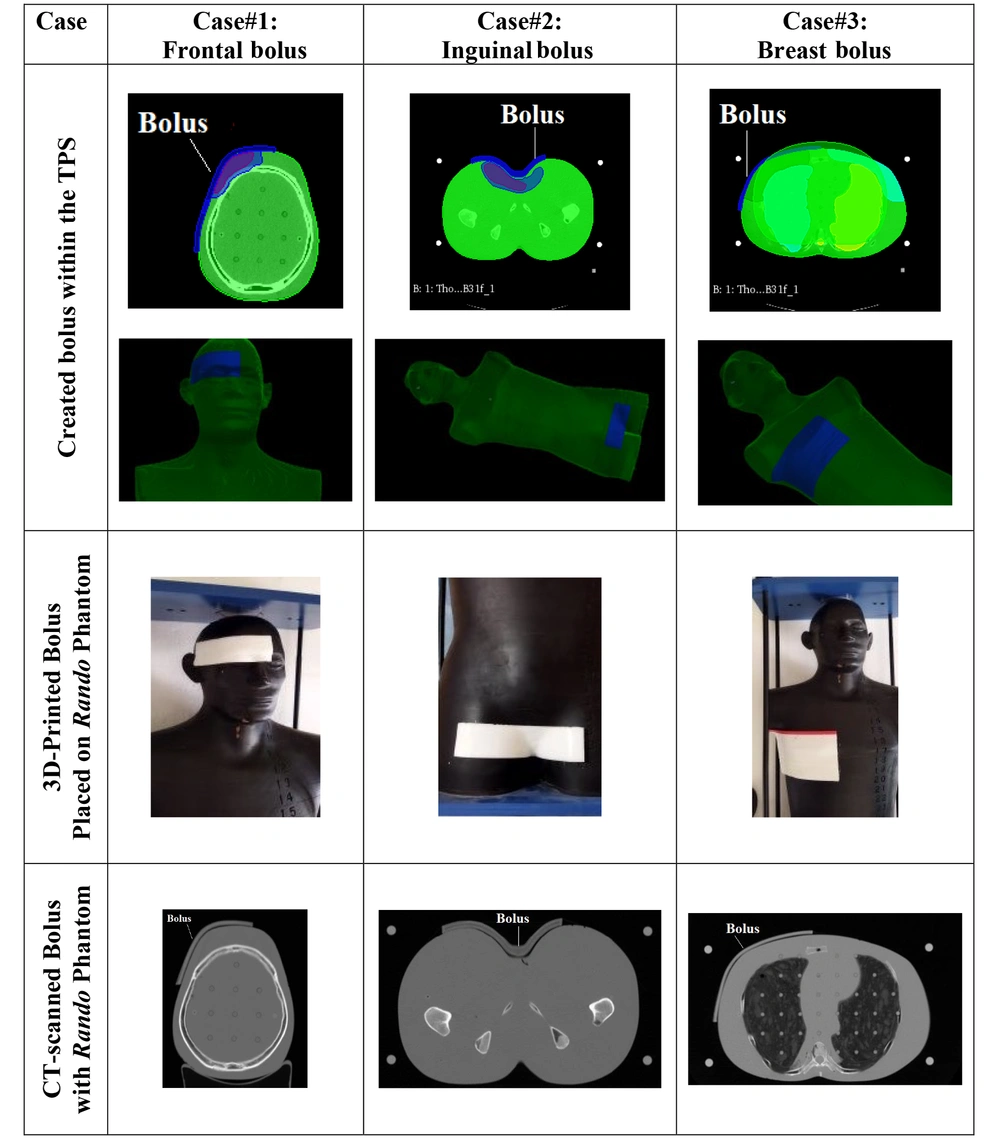
Table 1 presents images of the created and printed boluses for the 3 different treatment cases and locations. The 3D-printed boluses are placed on Rando phantom and CT-scanned to check the right positioning (3rd row). The CT data were also used for treatment re-planning with 3D-printed boluses in targeted places on Rando phantom. As can easily be checked on the figures of the last row of
Figure 1, the different boluses fit well with the received surfaces.
Created boluses, 3D-printed boluses, and fit them to the anatomy of the studied cases
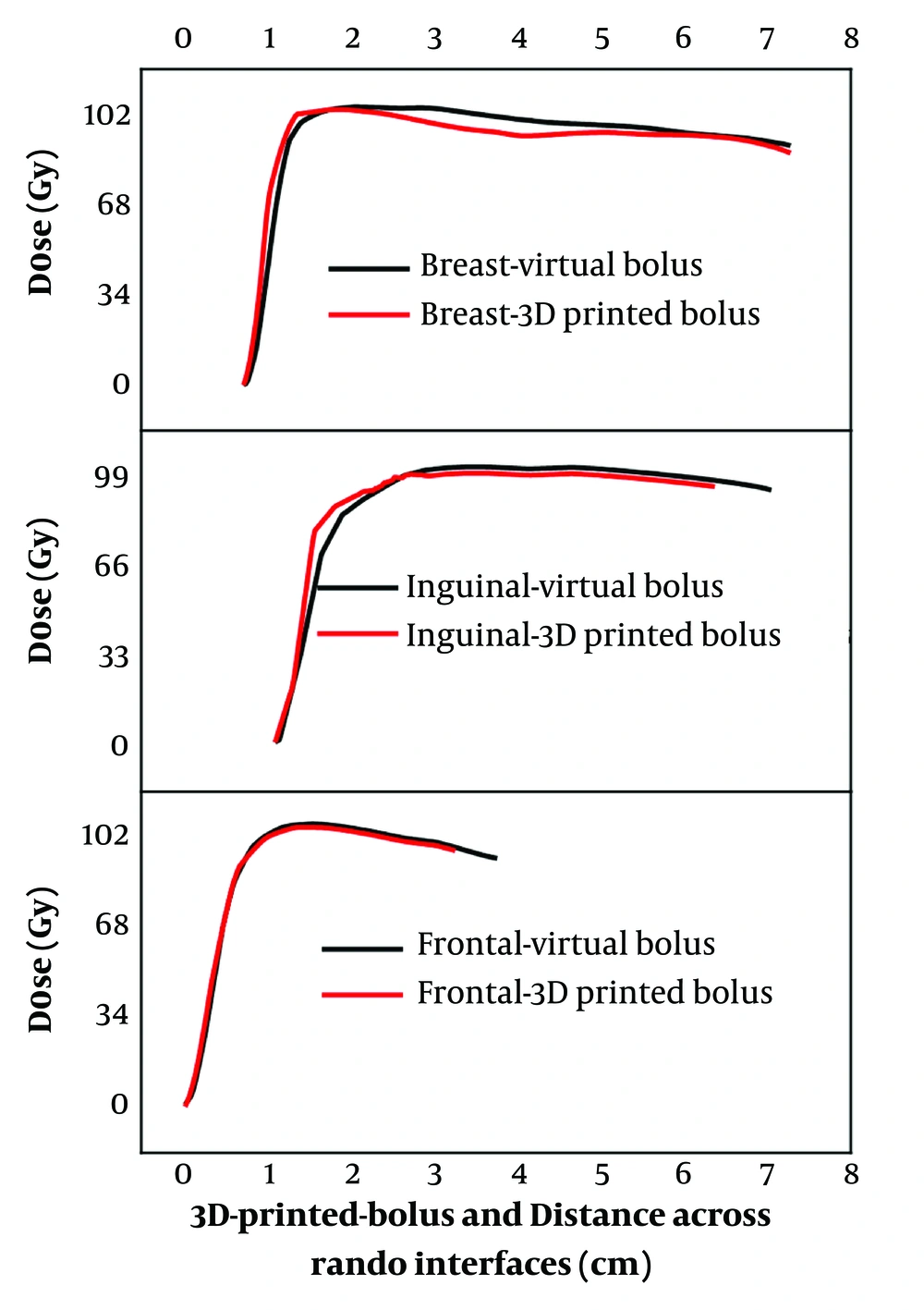
Figure 2 shows the lines of profiles of dose across the air/bolus-tissue interfaces. The results clearly demonstrate that in all the studied cases, there are no abrupt dose transitions as in the case of an interface including a heterogeneous medium. The boluses play their role in dose shifting toward depth without any comprise on the normal dose deposition, normal behavior in homogenous medium.
Dose profiles across Bolus and Rando interfaces for the different considered treatment cases and locations demonstrating continuous behavior without brutal changes.
The measured doses received by the PTV volumes with different percentages (D98%, D95%, D50%, D2%, and Dmean) as well as the HI and CI metrics are presented in
Table 2 for all the considered treatment cases, locations, and used TPSs.
| TPSs | Plans with Virtual Bolus | Plans with 3D-Printed Bolus |
|---|
| PTV Frontal | PTV Breast | PTV Inguinal | PTV Frontal | PTV Breast | PTV Inguinal |
|---|
| Eclipse | | | | | | |
| D98% | 37.323 | 37.423 | 9.339 | 37.337 | 37.435 | 9.335 |
| D95% | 38.119 | 38.168 | 9.526 | 38.119 | 38.166 | 9.526 |
| D50% | 40.771 | 41.314 | 10.208 | 40.771 | 40.826 | 10.237 |
| D2% | 42.99 | 42.482 | 10.625 | 42.99 | 42.209 | 10.525 |
| Dmean | 40.661 | 40.884 | 10.157 | 40.194 | 40.544 | 10.210 |
| HI | 0.140 | 0.126 | 0.128 | 0.141 | 0.119 | 0.119 |
| CI | 0.957 | 0.953 | 0.957 | 0.957 | 0.958 | 0.998 |
| Monaco | | | | | | |
| D98% | 38.125 | 39.340 | 9.866 | 37.806 | 39.221 | 9.970 |
| D95% | 38.967 | 39.808 | 9.962 | 39.019 | 39.672 | 10.034 |
| D50% | 41.505 | 41.300 | 10.312 | 41.530 | 41.080 | 10.284 |
| D2% | 42.610 | 42.141 | 10.542 | 42.706 | 42.183 | 10.532 |
| Dmean | 41.223 | 41.109 | 10.237 | 41.160 | 40.951 | 10.224 |
| HI | 0.112 | 0.069 | 0.067 | 0.122 | 0.073 | 0.056 |
| CI | 0.983 | 0.998 | 1 | 0.975 | 0.998 | 1 |
Abbreviations: TPS, treatment planning system; PTV, planning target volume; HI, Homogeneity Index; CI, Conformity Index.
When using the Eclipse TPS, D98% and D95% for both situations (designed virtual boluses and 3D-printed boluses) demonstrate almost identical coverage across all PTVs for the different considered cases (breast, inguinal, and frontal), suggesting similar dose coverage. D50% shows minor variation across the PTV, particularly in the breast case, where the 3D-printed bolus shows a slightly lower effective dose at the middle of the PTV (40.826 vs. 41.314). A slightly lower D2% is observed for the 3D-printed boluses, especially for the breast PTV (42.209 vs. 42.482), indicating a lower hot spot. Dmean of the 3D-printed boluses shows a negligible lower average dose across different PTVs, except a slight increase in the frontal PTV (40.194 vs. 40.661). The HI values are largely consistent between the virtual and 3D-printed boluses. The targeted homogeneities on the virtual boluses of the different considered cases were achieved by the 3D-printed boluses. The CI values for the 3D-printed boluses are very close to the values of the virtual boluses, showing good conformity for all PTVs. The slight increase in CI for the breast case (0.958 vs. 0.953) indicates that the 3D-printed bolus fits the received surface better than the virtual bolus.
Likewise, when using Monaco TPS, minor differences in D98% and D95% were observed. For example, for the frontal PTV, D98% of the 3D-printed bolus is slightly lower than that of the virtual bolus (37.806 vs. 38.125). D50% and D2% show slightly higher values for the 3D-pinted blouses compared to virtual boluses. Indeed, D2% for the inguinal PTV is slightly lower with the 3D-printed bolus (10.542 vs. 10.532), suggesting similar dose control as programmed by the clinician on the virtual bolus created within the TPS. The mean dose Dmean is similar across designed virtual boluses and 3D-printed boluses, indicating that the overall programmed dose delivery was achieved by the 3D-printed boluses. The HI of the printed boluses is conformed with that of the virtual boluses with insignificant differences. The CI values of the 3D-printed boluses also show an ideal matching when compared to those of the virtual boluses, especially in the inguinal PTV, where an ideal value of 1 is reported, reflecting perfect conformity with the target.
Doses received by the OARs are presented and compared in
Table 3 for the created virtual boluses and the effectively 3D-printed boluses by considering both Eclipse and Monaco TPSs. The doses received by the OARs (eyes, spinal cord, heart, and lungs) are within the limits on dose constraints (
15). The HDVs for PTV and OARs are presented in
Figures 3 and
4 for Eclipse and Monaco TPSs. The HDVs and extracted dose values between virtual and 3D-printed boluses are quite similar and closely aligned. Therefore, the treatment planning with the 3D-printed boluses all conforms.
| OARs | Eclips TPS | Monaco TPS |
|---|
| Plans with Virtual Bolus | Plans with 3D Printed Bolus | Plans with Virtual Bolus | Plans with 3D Printed Bolus |
|---|
| Brainstem (DMAX) | 0.617 | 1.001 | 0.818 | 0.893 |
| Right eye globe (Dmean) | 0.618 | 0.390 | 0.919 | 1.707 |
| Left eye globe (Dmean) | 2.499 | 0.951 | 11.213 | 7.557 |
| Spinal cord (DMAX) | 0.169 | 0.082 | 0.136 | 0.401 |
| Heart (Dmean) | 0.477 | 0.479 | 0.988 | 1.075 |
| Right lung (Dmean) | 8.161 | 7.588 | 7.795 | 7.695 |
| Left lung (Dmean) | 0.023 | 0.025 | 0.314 | 0.341 |
| Spinal cord (DMAX) | 0.183 | 0.203 | 0.450 | 0.489 |
Abbreviations: OARs, organs at risk; TPS, treatment planning system.
Dose-volume histograms (DVHs) of Eclipse treatment planning system (TPS) for the different considered treatment cases and boluses [virtual programmed (dot line) and 3D printed (solid line)]: A, Frontal; B, right breast; and C, inguinal.
Dose-volume histogram (DVHs) of Monaco treatment planning systems (TPS) for the different considered treatment cases and boluses [virtual programmed (dot line) and 3D printed (solid line)]: A, Frontal; B, right breast; and C, inguinal.
The above data and results highlight a high level of compatibility between the effectively 3D-printed boluses and the virtually created boluses (programmed) by the clinician within the TPS. All studied and 3D-printed boluses fit optimally with the received surfaces. The dose profiles across air-bolus-tissue interfaces reveal minimal perturbations, ensuring that the dose delivery remains accurate and effective even in the presence of varying densities. The targeted dose distribution in PTV and the constraints on the dose of the OARs were respected in all studied cases. For both Eclipse and Monaco TPSs, the obtained results demonstrate that the 3D-printed boluses for all the considered treatment cases and locations (breast, inguinal, and frontal) maintain effective dose coverage of the PTV. Values of D98%, D95%, D50%, D2%, and Dmean in PTVs all conform. The CI values are close to one (
1) in both used TPSs, indicating the conformity of dose delivery to the PTV with the 3D-printed boluses (
16). The obtained HI values indicate that the dose distribution within the PTV conforms to the prescribed dose in all considered cases (
12-
14). The similarities observed between OARs doses when comparing the programmed virtual boluses to the effectively 3D-printed boluses are certainly due to the powerful and accurate bolus reproduction aspect of the used 3D printing and modeling technologies. Indeed, dose distribution characteristics of the 3D-printed boluses produce similar results to the virtual ones, although the irregular morphology of certain regions and locations. In the studied cases, the overlapping anatomical contours of OARs result in similar dose distribution regardless of the type of bolus used (
17). Minor differences observed in mean and maximum doses are not clinically significant. The deviations in terms of doses are within the acceptable limits specified by the clinical protocol, which indicates that 3D-printed boluses are effective in sparing OARs without compromising the treatment efficacy. The observed difference between the two TPSs (Eclipse and Monaco) is due to the used dose calculation and optimization algorithms, resulting in tightly coordinated treatment plans.



![Dose-volume histograms (DVHs) of Eclipse treatment planning system (TPS) for the different considered treatment cases and boluses [virtual programmed (dot line) and 3D printed (solid line)]: A, Frontal; B, right breast; and C, inguinal.](https://brieflands.com/journals/ijcm/articles/159515/figures/ijcm-18-1-159515-i003-preview.webp "Dose-volume histograms (DVHs) of Eclipse treatment planning system (TPS) for the different considered treatment cases and boluses [virtual programmed (dot line) and 3D printed (solid line)]: A, Frontal; B, right breast; and C, inguinal.")
![Dose-volume histogram (DVHs) of Monaco treatment planning systems (TPS) for the different considered treatment cases and boluses [virtual programmed (dot line) and 3D printed (solid line)]: A, Frontal; B, right breast; and C, inguinal.](https://brieflands.com/journals/ijcm/articles/159515/figures/ijcm-18-1-159515-i004-preview.webp "Dose-volume histogram (DVHs) of Monaco treatment planning systems (TPS) for the different considered treatment cases and boluses [virtual programmed (dot line) and 3D printed (solid line)]: A, Frontal; B, right breast; and C, inguinal.")


